The recorded sessions from the 6th ALPHA MISSION – ΔELOS Global Gathering are now available on the World Human Forum YouTube channel

The Pulse of Life

The 6th ALPHA MISSION – ΔELOS Global Gathering, “The Pulse of Life: Re-connecting Personal to Planetary Health”, brought together leading voices from science, space exploration, ecology, architecture, archaeology and the arts in a profound dialogue on the living connections between humanity and the planet we call home. Across Mykonos and Delos, ancestral intelligence met contemporary knowledge, creating a space to consider how we can restore balance between human wellbeing and the health of Earth’s living systems.

ALPHA MISSION – ΔELOS 2026: “The Pulse of Life” begins in Mykonos

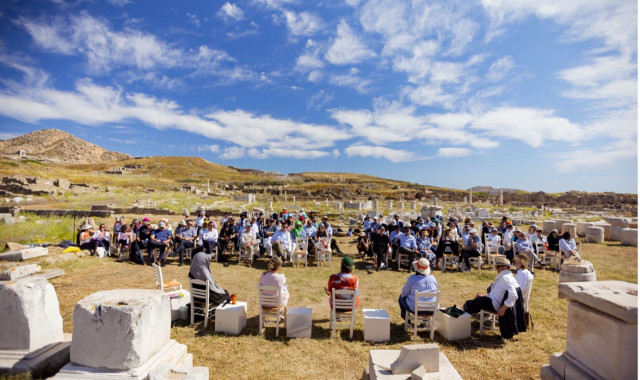
The conversation began in Mykonos, where, on Saturday, 16 May 2026, the speakers joined local residents for an open public event centred on some of the most defining questions of our time—from human health and environmental balance to our place in the cosmos. Opening remarks were given by Alexandra Mitsotaki (President & Co-founder, World Human Forum), Dimitris Papastergiou (Minister of Digital Governance, Hellenic Republic), and Christos Veronis (Mayor of Mykonos), before the audience was invited on a journey through ancient wisdom, planetary health and the cosmic perspective.

The profound connection between human wellbeing and the health of the planet was the focus of Professor Dimosthenis Sarigiannis’ talk, titled “One Health: Personal and Planetary”. Director and President of the Board of the National Hellenic Research Foundation (NHRF) and Professor of Environmental Engineering at the Aristotle University of Thessaloniki, Professor Sarigiannis drew from science and ancient Greek wisdom to show how our health is shaped by the air we breathe, the water we drink, the food we consume and the environments we create. “The pulse of life flows in both directions,” he said — the environment writes itself onto our biology, while our choices write themselves back onto the environment. Addressing climate change, water scarcity in the Cyclades, sustainable tourism and local food systems, he emphasised that personal health and planetary health are inseparable. The speaker was introduced by Vangelis Karkaletsis (President, NCSR “Demokritos”).

Exploring “The Ancient Wisdom of Healing”, Professor Vassilis Lamprinoudakis (Professor Emeritus of Archaeology, National and Kapodistrian University of Athens) reflected on the healing traditions of ancient Greece and their relevance today. The ancient Asclepieia embraced a holistic understanding of health: first calming the soul, then healing the body. Music, theatre, dreams, water, exercise and medicinal herbs all formed part of the healing process in these sanctuaries. Ancient healthcare was also characterised by a spirit of social justice, with access to healing offered under the same conditions to men and women, free citizens and slaves, rich and poor alike. The ancient world continues to offer valuable insights for the present, reminding us of a broader understanding of health and healing.

As evening fell, Dr Stamatios Krimigis (Emeritus Head, Space Exploration Sector, Johns Hopkins University Applied Physics Laboratory; former President, Academy of Athens) invited participants to view Earth from a cosmic perspective and recognise our responsibility towards our planet. In his lecture, “Planet Earth in Context, Solar System and the Galaxy — Can We Be Healthy in Outer Space?”, he guided the audience from the vastness of our galaxy to the unique conditions that make life possible on our “pale blue dot”. Drawing on decades of experience in space exploration, he reflected on Earth’s protective systems, the challenges of human spaceflight, and the search for life beyond our planet. His concluding message was clear: “We must forget about colonising space. We must protect the Earth for at least the next hundreds, if not thousands of years.” The speaker was introduced by Nick Sergis (CEO, Hellenic Space Center).

The day concluded with the award-winning film-concert The [Uncertain] Four Seasons, introduced by the soloists of the film, Diana Tishchenko and Sokratis Sinopoulos, extending the evening’s dialogue through music and image.

ALPHA MISSION – ΔELOS 2026: Science, Space and Planetary Health on Delos

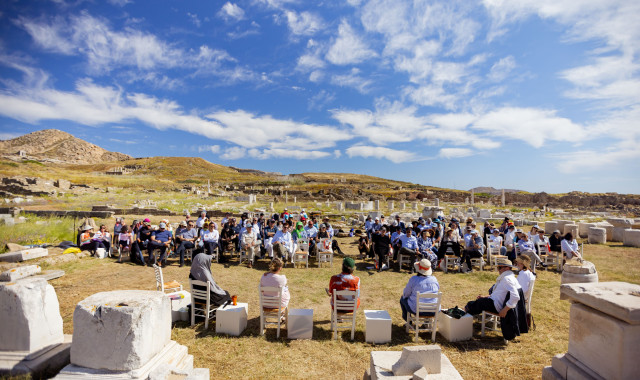
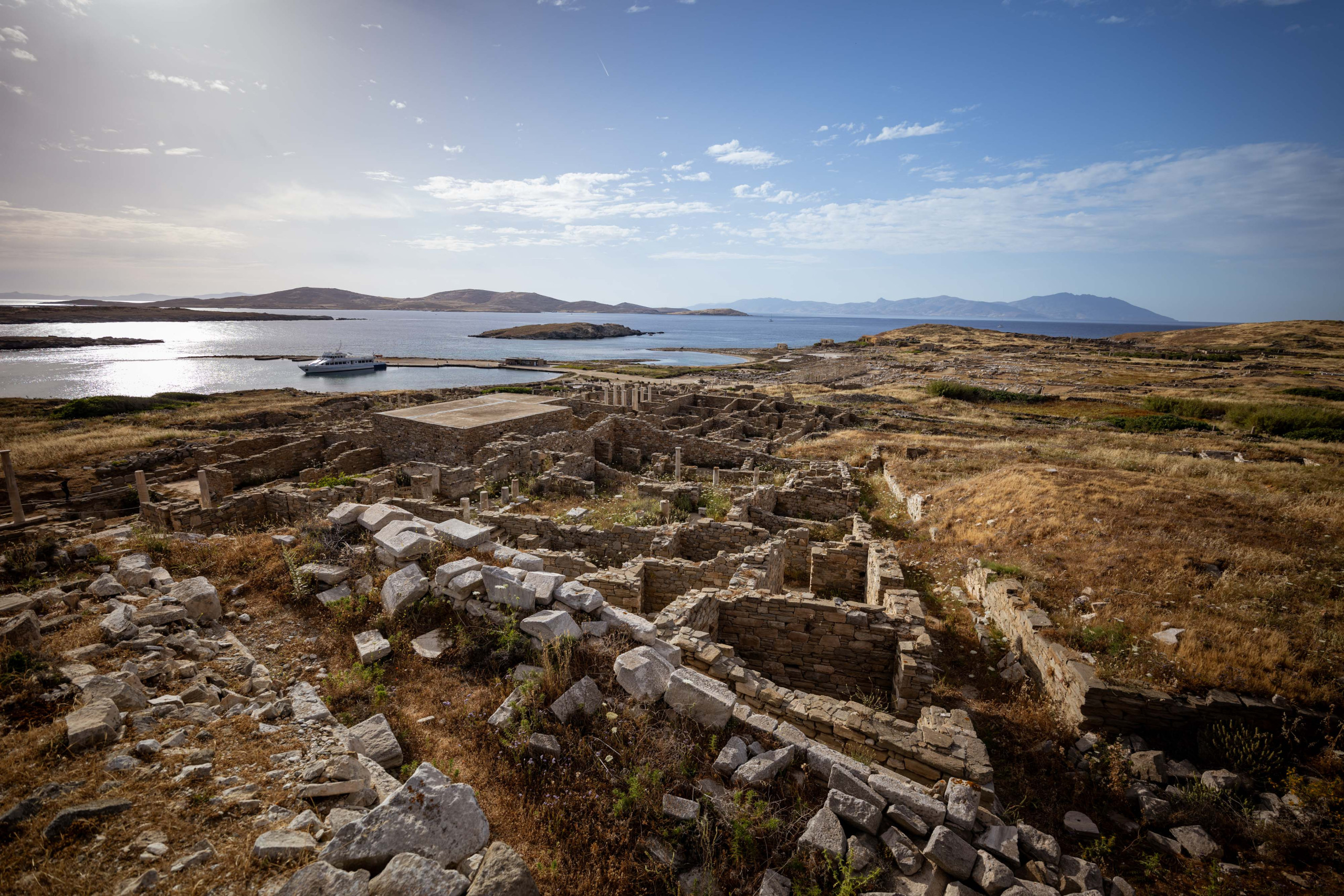
Sunday, 17 May 2026, began with an onboard presentation and guided talk by Professor Vassilis Lamprinoudakis on the Asklepieion of Delos and the ancient Greeks’ holistic approach to healing. Upon arrival on Delos, Alexandra Mitsotaki and Daniel Benardout (Chairman of the Board of Directors, Hellenic Post) introduced participants to the “Oneness, Wisdom, Life” sculptural installation at the port. Created by the renowned sculptor Praxiteles Tzanoulinos, it invites island visitors to a space of rest and reflection.

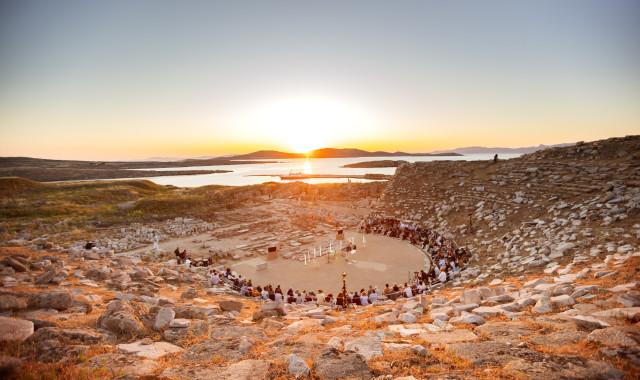
After a short walk through the impressive ruins of the ancient city, Demetris Athanasoulis (Director, Ephorate of Antiquities of Cyclades) welcomed participants to the theatre of Delos—one of only two marble theatres in the Cyclades and a principal gathering place of the local community in antiquity. He outlined the ongoing restoration projects on the site, including work on the Great Temple of Apollo and the Granite Palaestra, while emphasising the importance of connecting the values embodied in Delos’ monuments with contemporary society. In this context, he highlighted ALPHA MISSION – ΔELOS as an initiative that strengthens the connection between today’s communities and the island’s ancient cultural heritage.

Perspectives from space medicine, biology, and planetary science were brought together during the first panel of the day, titled “Can we flourish away from Planet Earth?”. Alexander Choukér (Academic Director, Senior Physician, Head of Research Laboratory I “Translational Stress and Immunity Research”, University Hospital Munich), Adrianos Golemis (Astronaut in Training; Collaborator, Hellenic Space Center; Lead Flight Surgeon, MEDES – European Space Agency), and Athena Coustenis (Director of Research, National Centre for Scientific Research / CNRS, France) examined what humanity’s journey beyond Earth teaches us about life, health, and our place in the universe. From the challenges of spaceflight on the human body to the search for life beyond our planet and the responsibility that comes with humanity’s journey into space, the discussion led to a profound realisation: the more we explore beyond Earth, the more we appreciate the uniqueness of our home planet — and the need to safeguard it.

The inseparable relationship between the wellbeing of people and the health of the planet emerged as the central message of the “One Health: Waters, Ecosystems, Humans” panel that followed. Professor Niki Evelpidou (Department of Geology and Geoenvironment, National and Kapodistrian University of Athens) outlined the accelerating impacts of climate change on coastlines, biodiversity and cultural heritage, while sharing how nature-based solutions can help restore balance. Professor Yadvinder Malhi (Professor of Ecosystem Science, University of Oxford) shed light on our profound connection to water and the biosphere, reminding us that human life depends on the health of Earth’s living systems. Jacob Moe (Founder & Director, Archipelago Network) demonstrated how traditional knowledge from the Cycladic islands offers valuable lessons for managing resources and living within environmental limits. The panel was moderated by Daniel A. Barber (Professor of Architecture and Chair of the Working Group on Architecture History and Decarbonisation, Technical University of Eindhoven).

Shortly after, Dr Alexis Paterson (Senior Music Programme Producer, Schwarzman Centre, University of Oxford) and Jochen Sandig (Co-founder & Vice President, World Human Forum) discussed the Schwarzman Centre for the Humanities and its upcoming collaborations with the World Human Forum. They introduced Orbiting Orbital — an artistic journey inspired by the Booker Prize-winning novel Orbital and developed with composer Nitin Sawhney, bringing together music, poetry, and art to reimagine our relationship with the planet, from the universal to the human, and beyond an anthropocentric perspective. And also, revealed news on the upcoming exhibition of renowned photographer Mary McCartney on Delos.

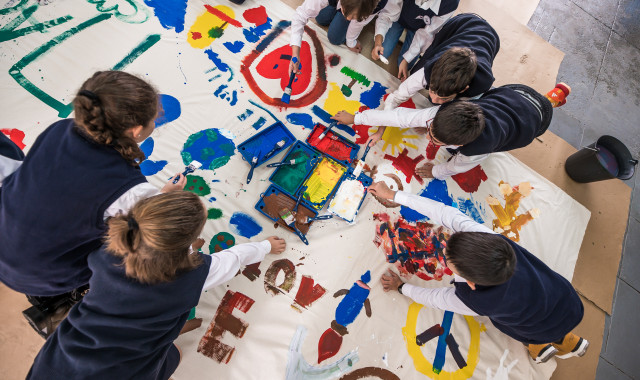
As the afternoon light softened across the Aegean, participants shared a collective message distilled through an interactive artistic workshop, weaving together colours, words and the sounds of traditional water whistles. They were also invited to join the concert The 5th Season, featuring Sokratis Sinopoulos (lyra) and Diana Tishchenko (violin), which brought the gathering to a close.

Let us hold on to their reflections: “The Earth is not silent. She speaks — can you hear her? / A tiny lifeboat, hanging quietly in the universe, blue and breathing in the dark / Planet Earth is blue and there’s something we can do / If we could carry our values into this fragile spaceship, let them be: love, respect, hope, compassion, roots, and time / Because in everything, we are nothing, but in that nothing, we are everything.”

Recorded sessions and activities from the 6th ALPHA MISSION – ΔELOS Global Gathering are available on the World Human Forum YouTube channel.