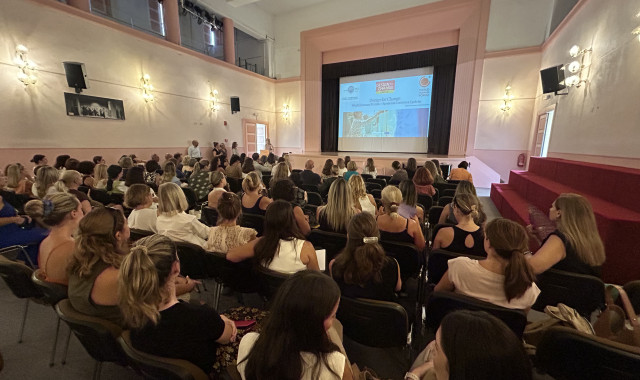
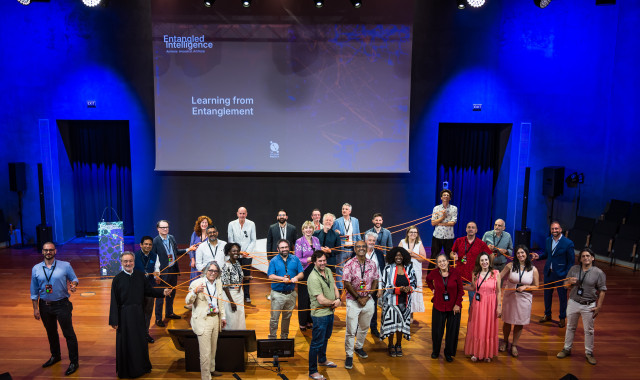
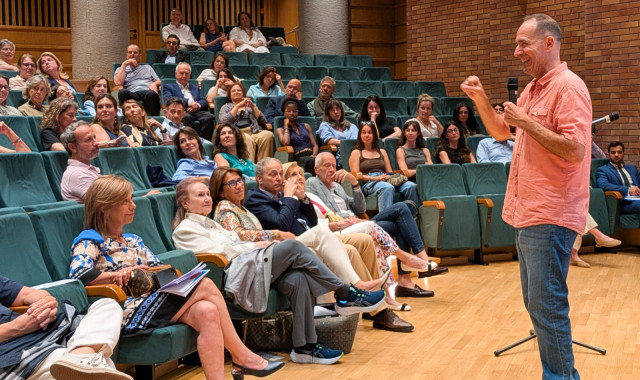
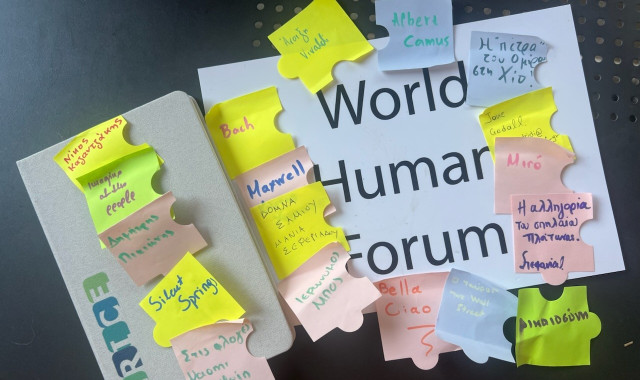
Megaron – The Athens Concert Hall was filled with children’s voices and youthful inspiration on 16 and 17 January. The 2nd Student Conference “From Mythology to Space”, this year entitled “Kids talk with the stars”, brought together students, parents and educators in a great celebration — by children, for children.
The conference was organised by the International Sustainability Education Network “From Mythology to Space – Myth2space” and the World Human Forum, in collaboration with the Hellenic Space Center, the National Centre for Scientific Research “Demokritos”, the Philekpaideftiki Etaireia (Arsakeia – Tositseia Schools), Megaron – TheAthens Concert Hall, and the National Museum of Natural History Goulandris. This fruitful convergence among leading institutions stands as a model for the importance of an interdisciplinary approach.
The International Sustainability Education Network “From Mythology to Space – Myth2space” is coordinated by the Directorate of Primary Education of B΄ Athens and the Directorate of Primary Education of the Cyclades.
Myth2Space in Action: Highlights from 16–17 January at the Megaron
Students from urban centres and the regions, both from Greece and beyond, presented their joint projects developed during the 2024–2025 school year. As part of the International Sustainability Education Network “From Mythology to Space – Myth2space”, they wrote poems and created e-books, explored the links between mythology and the constellations, created a theatrical performance reflecting on “the days of the future”, technological progress and the environmental crisis, became… space water explorers, and examined the contribution of women to science.
Participating with enthusiasm in their own conference, the students met peers, scientists, and artists. They unlocked knowledge about nature, science, and art through a series of revealing workshops and guided tours covering topics such as winds and waters, biodiversity, the Antikythera Mechanism, fake news, the ancient Greek seven-stringed lyre, and more. They showcased their work.
And there was more: they applauded the children from the Arsakeia Kindergartens who sang about the stars, as well as the melodic collaboration between the distinguished German-Greek pianist and co-founder of the Molyvos International Music Festival, Danae Doerken, “The Lyrists of the Library” from the Athens Music School, and the student pianist Eleonora Sechou.
“There are no limits to what you can imagine and create. Only your imagination, which gives birth to the dream of who we want to become and what we want to achieve in life, and the creative power that allows us to be inspired and find solutions to real-world challenges”, said Minister of Education, Religious Affairs and Sports, Sofia Zacharaki, at the opening of the conference. Commenting on the initiative’s impact, she added: “I am particularly pleased with how the Network has developed, as every year the participation of schools and students grows impressively, showing that this is a truly meaningful educational experience”.
Addressing the children, Professor Spyros Doukakis, President of the Institute of Educational Policy, emphasised: “The world will ask you not just what you know. It will ask you what kind of future you can imagine. And you are already doing so. Myths give you wings. Science gives you the map. You decide where and how you will fly. Look to the stars — but take care of the Earth that holds you. Dream freely — but build responsibly. And above all, believe that the world can change… because you are the ones who will change it”.
The conference was supported by a donation from Raycap S.A.
Media Sponsors: ΕΡΤ, ΕΡΤnews Radio 105,8
2nd Student Conference Myth2Space: Distinguished speakers — captivating presentations
In the packed Dimitris Mitropoulos Hall of Megaron – The Athens Concert Hall, distinguished figures in science, culture, society, and the environment took to the stage.
In his talk on “Innovation with Positive Social Impact”, Yannis Assael, Staff Research Scientist at Google DeepMind, highlighted the importance of testing unconventional ideas, pursuing our dreams, and adapting quickly to change, drawing on examples from research and interdisciplinary collaboration. He encouraged students to use knowledge and teamwork to make a positive contribution to the world, earning their enthusiastic applause. Responding to the children’s questions, he emphasised that artificial intelligence is a tool in human hands, capable of enhancing both human potential and its own effectiveness, and underlined the importance of using it responsibly.
Maria Efthymiou, Emerita Professor of History at the National and Kapodistrian University of Athens, delivered a message on the enduring significance of myths as tools for understanding humanity and society, both in the past and today. With references to Prometheus and Athena, she connected mythology to contemporary considerations on knowledge, vigilance, and the limits of human progress, emphasising the importance of critical thinking in facing modern challenges.
Titled “Biodiversity: Everything is Connected”, the talk by Fali Voyatzaki, President of the National Museum of Natural History Goulandris, focused on the profound relationship between humans and nature, as well as the urgent need to address the environmental crisis. Referring to climate change and biodiversity loss, she emphasised the role of science, education, and collective responsibility. She urged the children to listen to the “voice of the Earth” and to actively contribute to shaping a new ecological civilisation.
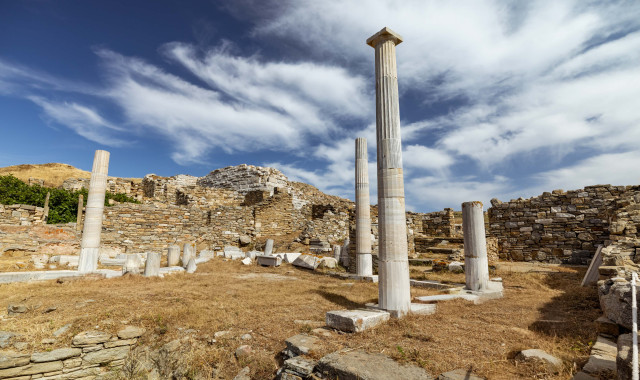
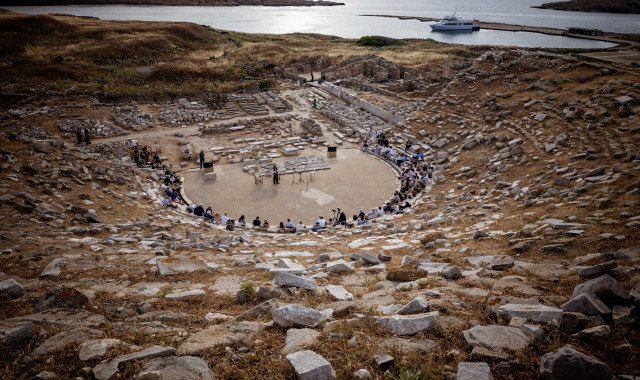
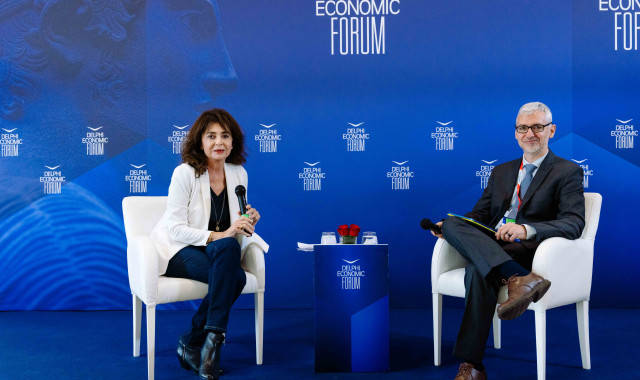
Alexandra Mitsotaki, co-founder and President of the World Human Forum, presented Alpha Mission Δelos, the initiative that inspired the creation of the “Myth to Space” Network. The goal of AMD is to raise awareness of environmental issues and foster a life-affirming civilisation that respects and safeguards our only home, planet Earth. She highlighted the interdependence of all forms of life and stressed that tackling these challenges requires both the sciences and the humanities, as well as the wisdom of our ancestors.
Myrto Vounatsou, Artistic and Creative Director of the World Human Forum, highlighted the power of art as a means of connecting people with one another, with themselves, and with nature, as well as a tool for cultivating ecological awareness. Through the “Green Tales” programme, she illustrated how children from different countries, using art and simple technology, told stories with an environmental message. Through art and collective creation, children learn to collaborate, express themselves, and develop a sense of responsibility towards nature.
Anezina Solomonidou, Planetologist and Senior Scientist at the Hellenic Space Center, invited the children on an imaginative journey through our solar system, exploring the timeless question of whether life exists beyond Earth. She focused on the icy moons of the giant planets, such as Europa, Enceladus, and Titan, explaining why their subsurface oceans are considered potential habitats. She emphasised that science, through careful inquiry, questioning, and space missions, helps us understand our place in the universe.
Niki Evelpidou, Professor of Geology and Geoenvironment at the University of Athens, shed light on how Greek myths (e.g., Enceladus, Hercules, Ariadne) contain real geological knowledge and reveal the ways in which people of the past interpreted natural phenomena such as earthquakes, floods, and changes in the landscape. She also showed how science “reads” the Earth to understand the past and anticipate the future, noting that careful observation of nature can also lead to modern solutions for environmental protection.