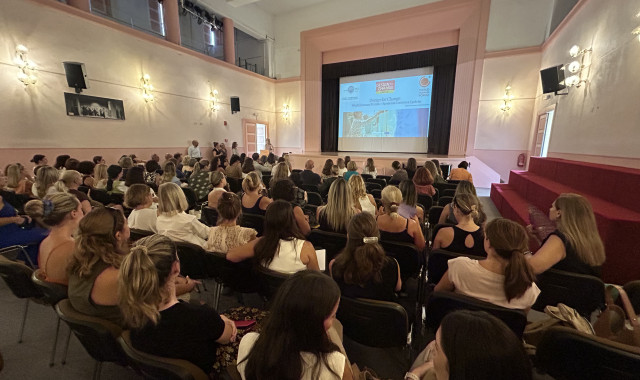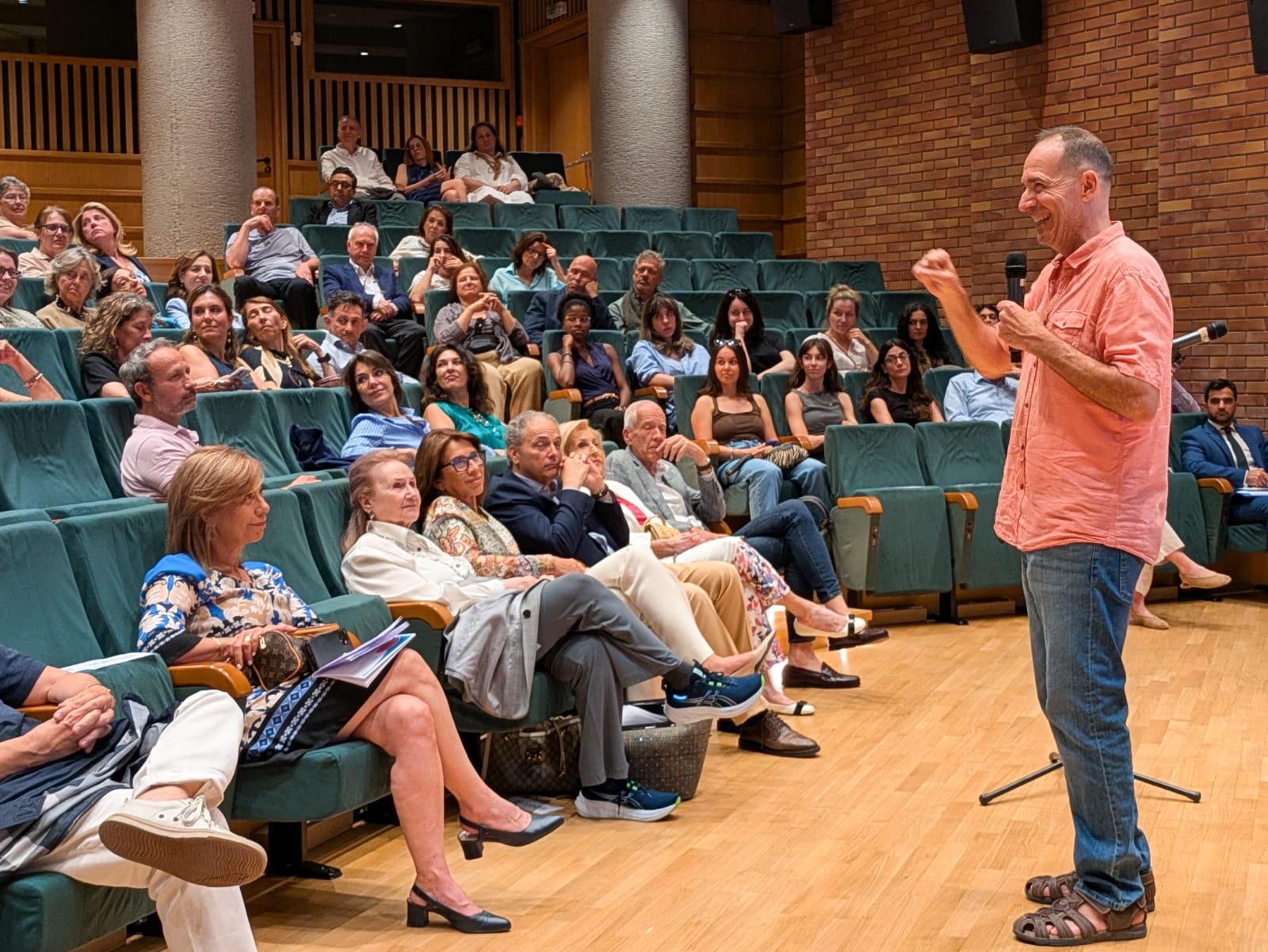
As part of The Lyceum Project 2026, themed “Entangled Intelligence: Animate. Ancestral. Artificial.”, the National Centre for Scientific Research “Demokritos”, the World Human Forum and the National Museum of Natural History Goulandris organised an event at the Museum on Thursday 18 June, featuring Paco Calvo, Professor of Philosophy of Science at the University of Murcia, Spain, and author of Planta Sapiens, as the keynote speaker.
Welcoming guests from Greece and abroad, Fali Vogiatzaki, President of the Museum, highlighted the Gaia Centre as the ideal setting for a discussion on intelligence, nature and humanity’s relationship with the living world. Referring to the vision of Angelos and Niki Goulandris, who founded the Museum in 1964, she emphasised that humanity’s future depends on a deeper understanding of, and a more meaningful respect for, nature. Nature, she stressed, is not merely a resource, but a source of knowledge, healing and wonder.
Alexandra Mitsotaki, President and Co-Founder of the World Human Forum, underlined that the event, as part of The Lyceum Project 2026, seeks to foster dialogue and interaction between three forms of intelligence: animate intelligence— the intelligence of nature and living systems; ancestral intelligence — accumulated through human experience, philosophical traditions and Indigenous knowledge; and artificial intelligence — the machine intelligence that is rapidly transforming contemporary life.
Paco Calvo on Intelligence
In his lecture, Professor Calvo challenged anthropocentric, zoocentric and neurocentric conceptions of intelligence. Rather than regarding a brain, a nervous system or the capacity for movement as necessary preconditions for cognition, he invited the audience to turn to organisms that appear more distant from humans — such as plants and even single-celled life — in order to explore what may fundamentally unite all living beings.
Drawing on examples from the plant world, Calvo discussed circadian rhythms, the folding and unfolding of leaves, plant melatonin, “plant jet lag”, adaptive responses to environmental regularities, and the capacity for learning without a brain or nervous system. These examples point towards forms of prediction, communication and adaptation that invite us to understand cognition as something more deeply rooted in life itself.
A central theme of the lecture was co-evolution: living beings do not evolve in isolation, but through continuous relationships with other cognitive agents. Calvo highlighted the dynamic interaction between flowers and pollinators as an example, suggesting that intelligence may be understood not simply as a property of an individual organism, but as something that emerges through networks of interaction, perception and response.
He also called on the scientific community to remain open to questions that may initially appear unconventional. The possibility of intelligence or sentience in plants should not be dismissed simply because it challenges established categories or creates ethical discomfort. Scientific progress requires us to formulate better questions, design better experiments, and maintain the humility to recognise that future generations may regard some of today’s certainties about cognition as incomplete.
Nature, therefore, can no longer be understood simply as a resource, but must also be recognised as a source of knowledge, healing and wonder. Addressing today’s ecological, social and technological challenges consequently requires an interdisciplinary approach grounded in ethical responsibility.
The concept of intrinsic intelligence should not be confined exclusively to humans, animals, brains or machines, but recognised as an autonomous property of living systems more broadly. Plants offer compelling examples of adaptation, prediction and responsiveness to environmental patterns, while evolution itself can be more fully understood as a process of co-evolution, unfolding through networks of relationships, interaction and interdependence.
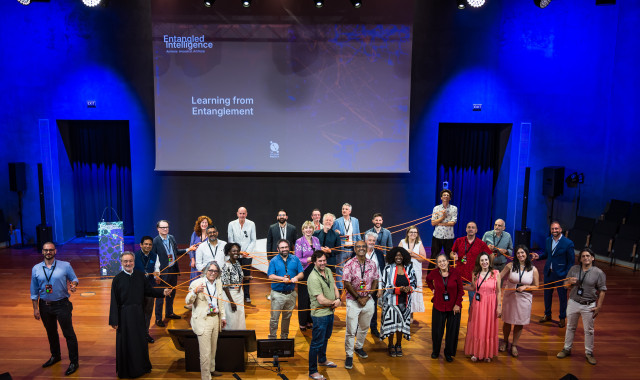
The Lyceum Project speakers at the National Museum of Natural History Goulandris
The event concluded with a guided tour of the Herbarium of the National Museum of Natural History Goulandris for the speakers of The Lyceum Project 2026. The tour was led by Dr Dionysis Mermygkas, Head of the Department of Botany.
Among those attending were Ruth DeFries, Professor of Ecology and Sustainable Development at Columbia University and Co-Founding Dean of the Columbia Climate School; Yadvinder Malhi, Professor of Ecosystem Science at the University of Oxford; Morten Kringelbach, Professor of Neuroscience at Aarhus University, Director of the Centre for Eudaimonia and Human Flourishing, and Fellow of Linacre College; Niki Evelpidou, Professor in the Department of Geology and Geoenvironment at the National and Kapodistrian University of Athens; and Emmanouel Stratakis, Research Director and Deputy Director of the Institute of Electronic Structure and Laser at the Foundation for Research and Technology – Hellas (FORTH).
Watch the full lecture on BLOD (Bodossakis Lectures on Demand) here